Session Overview
Beyond Pattern Recognition — Building Truly Human-Like Machines.
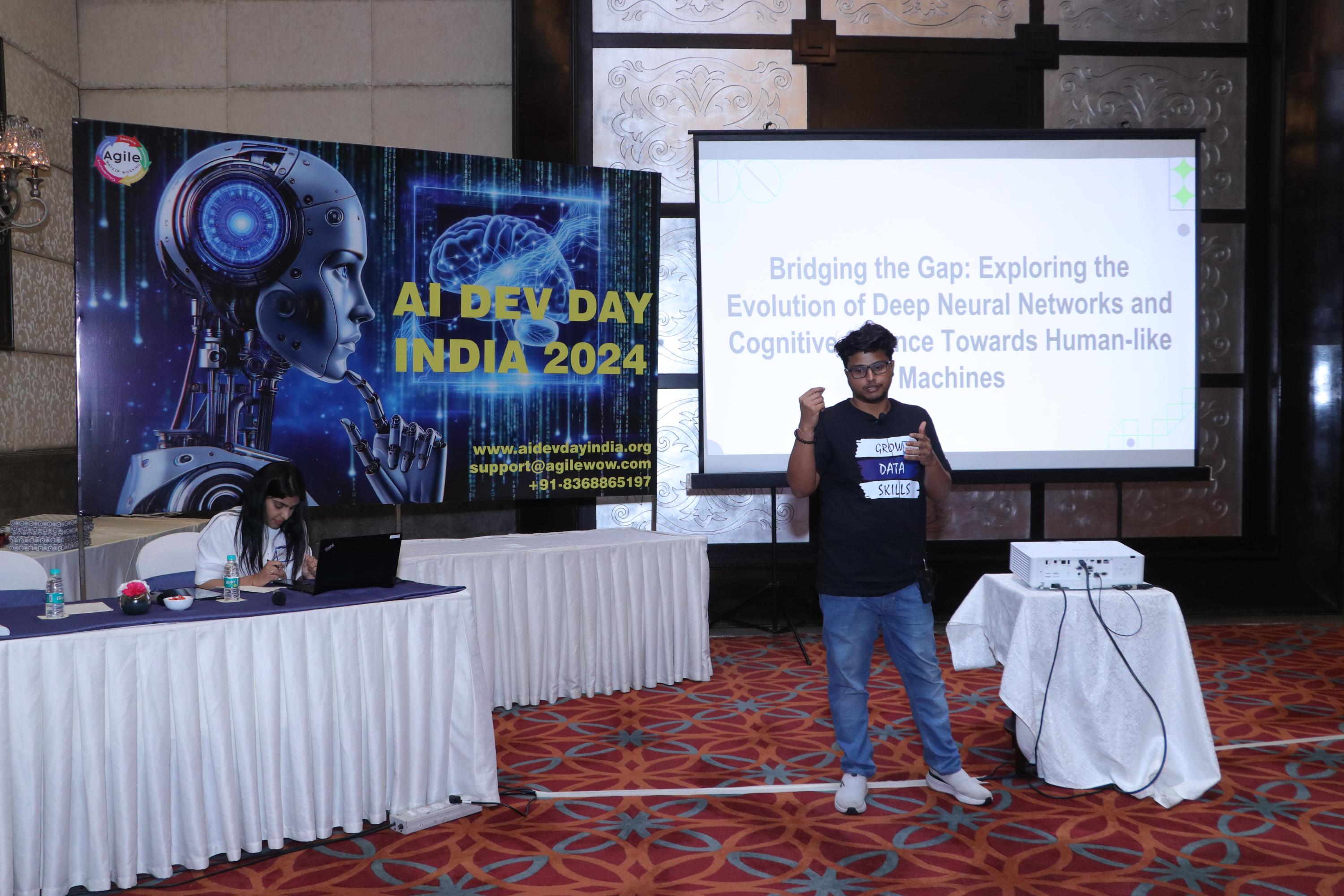
Shubhankit opened by drawing a clear line between traditional Machine Learning and Cognitive Science. Where ML feeds historical data into algorithms to find patterns — like predicting whether a loan gets approved — Cognitive Science is an interdisciplinary field spanning psychology, neuroscience, linguistics, and philosophy that studies exactly how the human brain computes information. His core argument: integrating cognitive science into AI is what will take machines beyond pattern recognition and toward genuinely human-like intelligence.
He outlined three hurdles traditional AI can't clear on its own — emotional complexity, contextual understanding, and ethical judgment — and explained how closing that gap means designing AI to mimic the brain's own processes: the human memory cycle of encoding, storing, and recalling information, and the dual modes of attention, sustained focus on long-term goals and selective filtering of distractions. The theoretical path forward involves building massive AI models with complex perceptrons, exposing them to social situations, and mapping their responses back to human brain behavior — work that's currently limited by the fact that researchers can't ethically experiment on live human brains.
He closed by outlining what "Smart AI" could unlock — from AI teachers offering customized pacing in under-resourced rural schools, to early disease detection in areas with a doctor shortage, to autonomous systems making human-like decisions in places humans can't survive, like deep space or Antarctica. But he was clear that some human traits — like an inherited calm temperament coded into our DNA — simply can't be replicated by AI, and urged the audience to see AI not as a job threat, but as a tool that can make workers up to five times more productive.
Key Takeaways & Concepts
Presentation Deck
Follow along with the slides used in the session:
Session Highlights