Session Overview
Small Language Models, Autonomous Weapons, and the Human in the Loop.
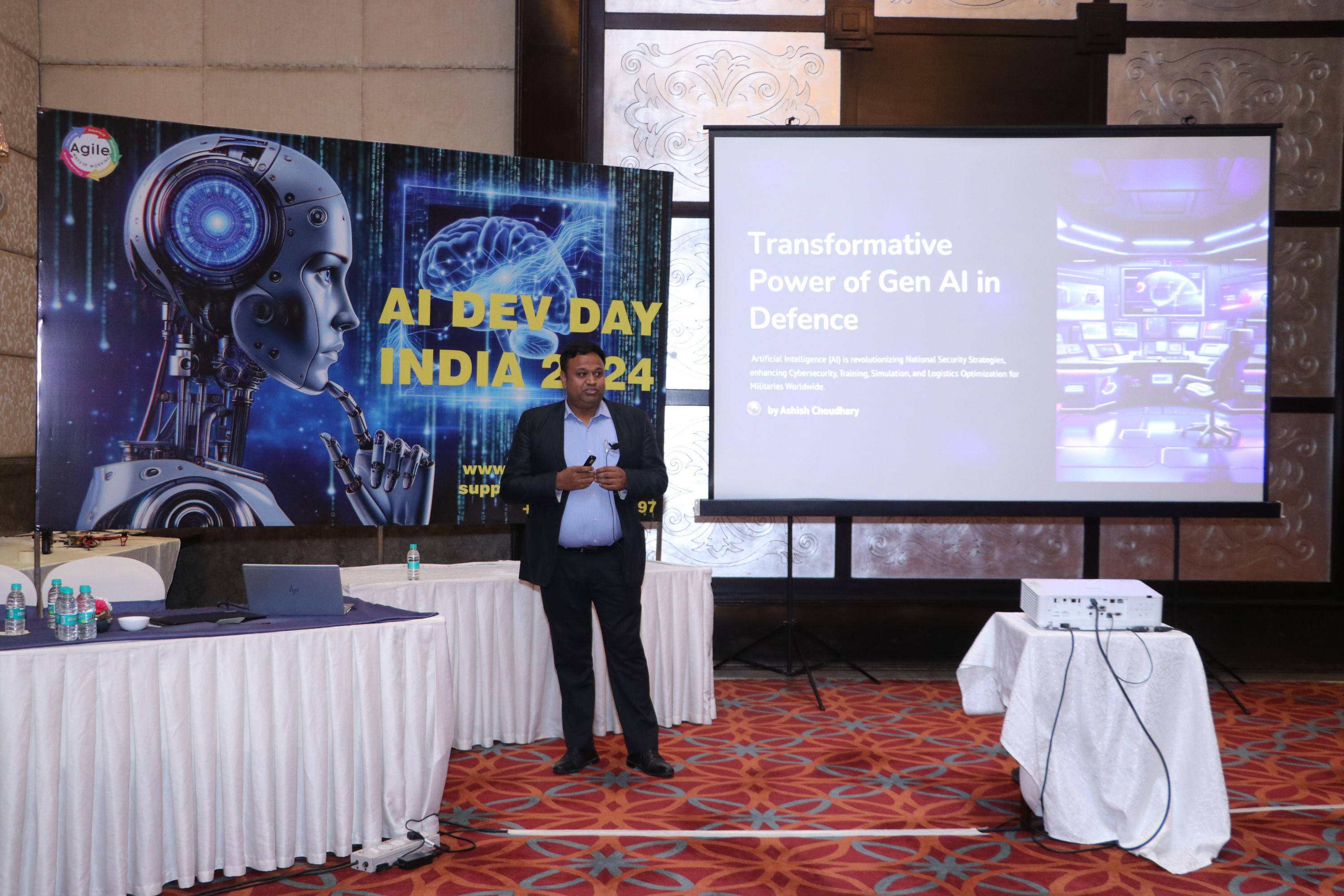
Ashish Choudhary framed Generative AI in the military not as a silver bullet, but as a way to automate highly structured, repetitive tasks — with armed forces globally exploring it for national security strategy, training simulation, logistics, and cybersecurity. He walked through concrete applications: a pilot project for the Indian Air Force that digitized complex aircraft maintenance knowledge from veterans into an interactive training platform for new recruits, efforts to push decision-making data from central "War Rooms" out to operational task forces on the ground, and predictive logistics systems like the French software "Masa" that model troop movements and shortest-path deployments. On the intelligence side, generative AI is now used to synthesize years of satellite data to spot enemy movement — work that used to require tedious manual analysis.
Because military data is highly classified, he explained why defense organizations can't risk cloud-based models like ChatGPT, and are instead investing heavily in Small Language Models that run locally — which also reduces hallucination risk when trained on tightly scoped, classified data. This set up the session's central tension: autonomous weapons like the kamikaze and swarm drones already in use in Ukraine and Israel raise serious accountability questions, since many operate on simple GPS programming without a "human in the loop." A US-led coalition of 16 countries is now working to build an international legal framework around this.
He closed on two sobering notes: the extreme danger of algorithmic bias on the battlefield — where a poorly trained facial recognition targeting system could be misused against people based on skin color or religion — and the broader geopolitical picture, where the world is now in an autonomous weapons race between the US and China. For a neighboring country like India, this poses a direct national security concern, and the Indian government is responding by opening collaborations with the tech startup ecosystem to rapidly build indigenous autonomous AI capabilities.
Key Takeaways & Concepts
Presentation Deck
Follow along with the slides used in the session:
Session Highlights