Best AI Tools for Academic Research 2026: The Ultimate Productivity Stack for PhDs
Quick Summary: Key Takeaways
- Slash Reading Time: Learn how tools like Elicit and Research Rabbit automate literature reviews.
- Write with Confidence: Discover writing assistants that polish your academic tone without plagiarism risks.
- Analyze Faster: From NVivo to Python, see how AI accelerates data processing.
- Perfect Citations: Automate your bibliography and never manually format a reference again.
- Visual Impact: Create publication-ready figures even if you have zero design skills.
The hunt for the best AI tools for academic research 2026 stops right here.
Drowning in a sea of PDFs and facing the blinking cursor of a blank thesis page is a rite of passage for every PhD student, but it doesn't have to be your permanent reality.
The New Era of the PhD Workflow
Academia has changed. It is no longer just about who works the hardest; it is about who works the smartest.
Finding the best AI tools for academic research 2026 isn't about cheating. It is about offloading administrative drudgery so you can focus on critical thinking.
Whether you are in STEM or the Humanities, the tools below represent the gold standard for the modern researcher.
1. Literature Search: Stop Wasting Months on Manual Reviews
Remember the days of endless keyword guessing in Google Scholar? They are over.
Modern AI tools function like a super-powered research assistant. They don't just find papers; they map connections, summarize abstract concepts, and highlight research gaps.
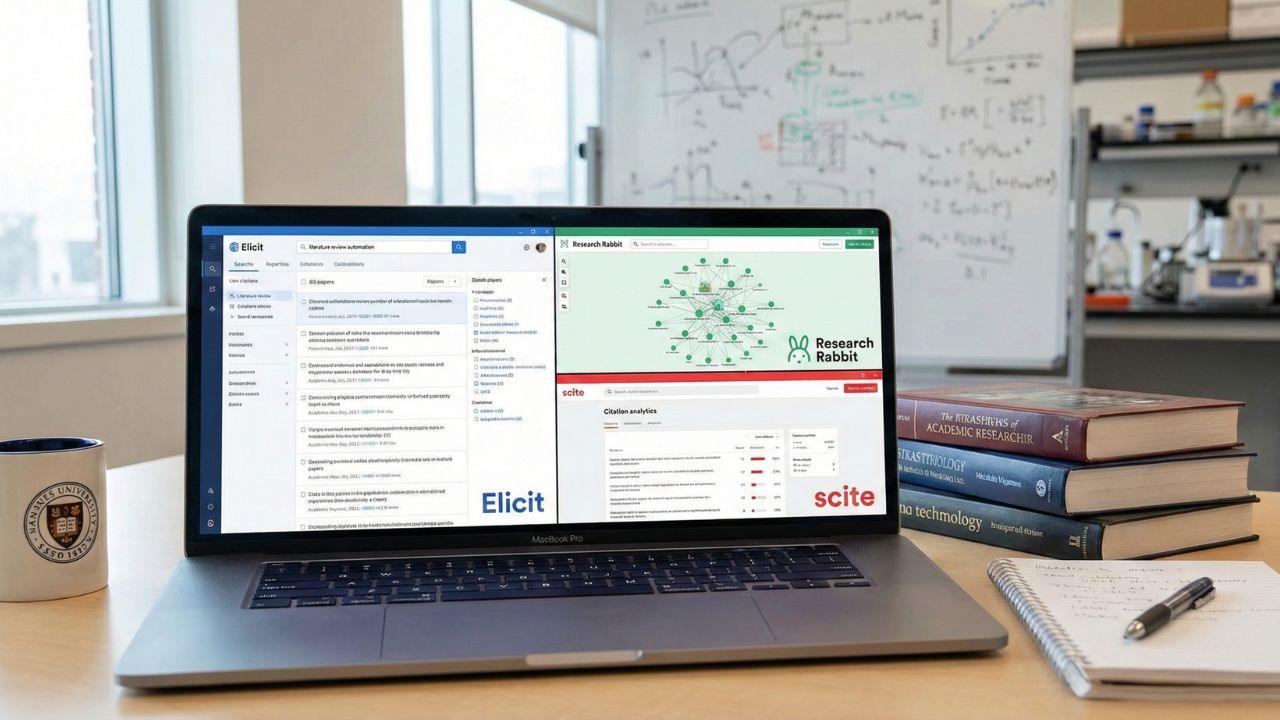
Tools like Elicit and Research Rabbit are leading this revolution. They allow you to ask natural language questions and receive answers backed by citations.
However, each tool has a specific strength. Elicit is superior for extracting specific data points across multiple papers, while Research Rabbit excels at visual mapping.
To master these specific platforms, read our deep dive on How to Use Elicit and Research Rabbit for Literature Search.
2. Writing Assistants: Draft Faster Without Losing Your Voice
Writer’s block is the enemy of the finished thesis.
AI writing assistants have evolved beyond simple spell-checkers. Tools like Gemini and SciSpace can help you brainstorm arguments, outline chapters, and refine technical language.
The goal isn't to let the AI write for you. It is to use AI to improve the flow and clarity of your own ideas.
Many students worry about the ethics of using these tools. The key is to use them for feedback and structure, not content generation.
If you are struggling with your dissertation draft, check out our comparison of the Best AI Writing Assistants for Thesis and Research Papers.
3. Data Analysis: From Raw Data to Actionable Insights
Data analysis used to require agonizing weeks of coding or manual coding of qualitative transcripts.
Now, AI acts as a co-pilot for your data. For qualitative researchers, tools integrated into NVivo can identify themes and sentiment in seconds.
For quantitative research, Julius AI and Python libraries allow you to chat with your dataset, asking for graphs and statistical tests in plain English.
This democratization of data science means you spend less time debugging code and more time interpreting results.
Ready to upgrade your analytical stack? Explore our guide on AI Data Analysis Tools for Research.
4. Citation Management: Never Fix a Bibliography Manually Again
There is nothing more painful than formatting a bibliography at 3 AM.
While Zotero and Mendeley are staples, their new AI integrations take them to another level. Imagine a tool that not only formats your citations but also scans your library to suggest missing metadata or relevant papers you overlooked.
Automation is the only way to handle the hundreds of references required for a doctoral thesis.
Learn how to set this up in our step-by-step tutorial: How to Automate Academic Citations with AI Tools.
5. Scientific Illustrations: Create Journal-Ready Figures
A great paper can be rejected because of poor figures.
You don't need to be a graphic designer to create professional diagrams. AI tools are bridging the gap between complex data and beautiful visualization.
BioRender is the industry standard for life sciences, while Canva and Figma are increasingly used for academic posters and conceptual flowcharts.
These tools ensure your visual communication is as strong as your written argument. Stop struggling with Paint or PowerPoint.
See what’s possible in our review of AI Tools for Scientific Illustrations.
6. Collaborative Research: Sync Your Lab in Real-Time
Research is rarely a solitary pursuit anymore. Managing a lab team, sharing large datasets, and co-writing papers requires robust infrastructure.
Notion has become a favorite for managing project timelines, while Overleaf remains the king of collaborative LaTeX writing.
When you add AI automation to these platforms, you get a virtual lab manager that keeps everyone on track.
To streamline your team's workflow, read about the Best AI Collaboration Tools for Research Teams.

Frequently Asked Questions (FAQ)
The top contenders are Elicit, Research Rabbit, and Scite. Elicit is best for extracting data, Research Rabbit for visual mapping, and Scite for verifying citation reliability.
Gemini is excellent for brainstorming outlines, simplifying complex jargon, and acting as a conversational partner to overcome writer's block. It should not be used to generate the core text of a thesis.
It depends on your need. Elicit is better if you have a specific research question and need to compare methodologies across papers. Research Rabbit is better for exploration and finding "seed" papers.
Zotero (with plugins) and EndNote remain the most reliable. New AI features in these tools help correct metadata and automate formatting styles like APA 7th edition.
Yes. NVivo's automated insights can help auto-code transcripts for sentiment and themes, drastically reducing the time needed for initial data sorting.
Sources & References
- How to Use Elicit and Research Rabbit for Literature Search
- Best AI Writing Assistants for Thesis and Research Papers
- AI Data Analysis Tools for Research
- How to Automate Academic Citations with AI Tools
- Nature: Tools for modern research
- Zotero: AI Plugins and Features
Internal Resources:
External Authorities: