The Secret AI interview hub Recruiters Don't Share
Key Takeaways:
- Beyond LeetCode: Understand why modern technical screens evaluate architectural intuition over generic coding puzzles.
- Product Leadership: Learn to navigate the "AI Flywheel" and avoid standard Agile pitfalls.
- Strategic Credentials: Focus on AI-augmented workflows and Human-in-the-Loop processes rather than outdated local certifications.
Traditional interview preparation is no longer enough to land a role in the high-stakes world of artificial intelligence and machine learning. Most candidates rely on outdated coding puzzles and generic behavioral templates, only to find themselves blindsided by technical screens that demand deep architectural intuition.
This definitive guide serves as your comprehensive AI interview hub, providing the roadmap to master the exact competencies top-tier firms are hiring for in 2026.
Executive Summary: AI Interview Success Checklist
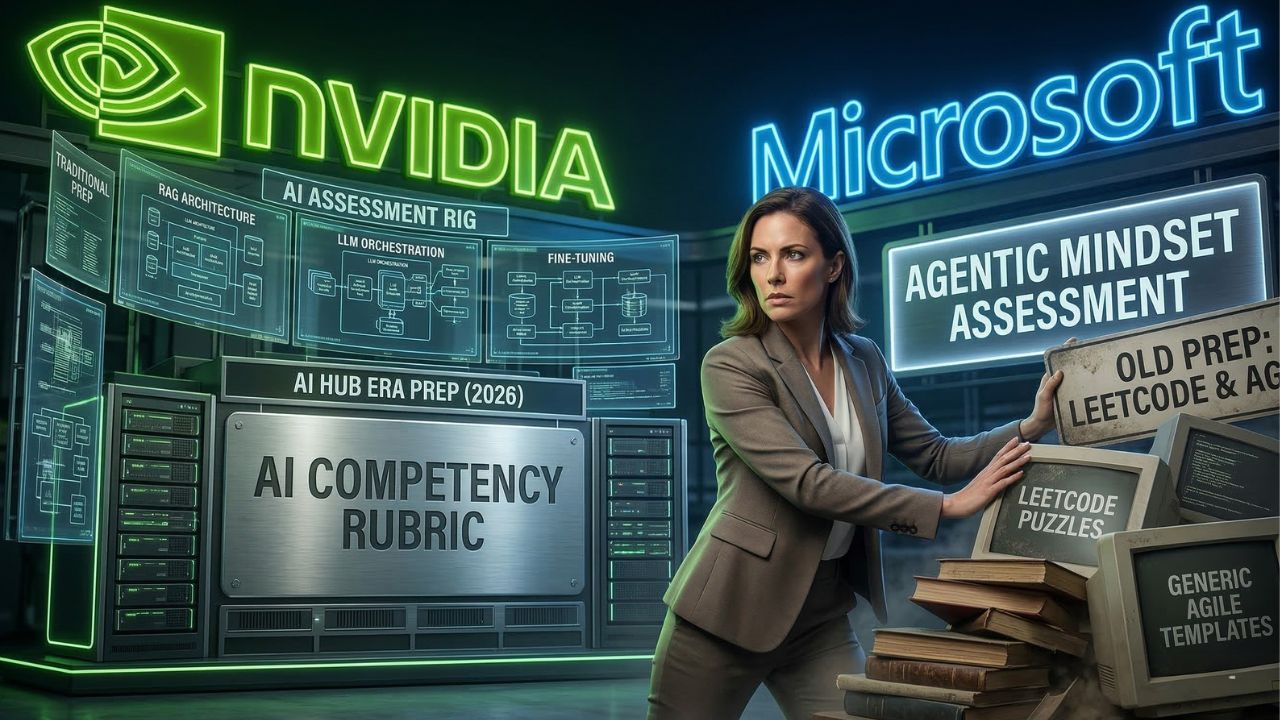
| Focus Area | Traditional Prep | AI Hub Era Prep (2026) |
|---|---|---|
| Technical Core | LeetCode & Algorithms | RAG, LLM Orchestration, & Fine-tuning |
| Product Sense | General User Journeys | AI Ethics, Agentic Workflows, & ROI |
| Methodology | Standard Agile/Scrum | AI-Augmented Agile & Human-in-the-Loop |
| Credentials | General Certificates | Specialized AI-Training & Advanced Agile |
| Outcome Goal | Pass the Screen | Prove Strategic Value & Technical Depth |
The Evolution of the Technical Screen: Beyond LeetCode
In the current market, recruiters have shifted away from testing rote memorization of sorting algorithms toward evaluating your ability to build and scale intelligent systems.
An effective AI interview hub must prioritize the intersection of software engineering and data science. Hiring managers are looking for "T-shaped" professionals, those who have a broad understanding of the tech stack but deep expertise in specific AI domains.
The technical landscape now demands a mastery of Retrieval-Augmented Generation (RAG) and the ability to discuss the trade-offs between model latency and accuracy. When you enter a high-level technical screen, you aren't just being asked "how" to code; you are being asked "why" a specific architecture was chosen over another.
Understanding the Neural Network of Hiring
Major industry players like NVIDIA and Microsoft have revolutionized their hiring pipelines. They utilize specific "AI Competency Rubrics" that measure your ability to handle non-deterministic outputs.
If you cannot explain how to mitigate "hallucinations" in a production-level LLM application, you are unlikely to pass the initial technical evaluation.
Mastering the Product Leadership Interview
For those pursuing leadership or product-oriented roles, the challenge is even more nuanced. A Product Owner in 2026 is expected to understand the nuances of the "AI Flywheel", how data collection improves models, which in turn improves user experience and drives more data.
Generic agile theory is the fastest way to bomb a tech interview in this niche. You must be prepared to discuss the specific frameworks for AI product discovery and how to measure the success of generative features.
Industry Warning: The "Agile Trap"
Many Product Managers fail because they apply standard Scrum cycles to AI development without accounting for the unpredictable nature of model training and data cleaning.
You must demonstrate how you adapt your roadmap to account for the "research" phase of AI development. If you are aiming for these high-level roles, you need to be prepared for AI interview questions for product owners that test your ability to bridge the gap between technical constraints and business ROI.
The Information Gain: The "Prompt Engineering" Fallacy
One of the biggest misconceptions currently circulating in the industry is that "Prompt Engineering" is a standalone career path.
In reality, the most successful candidates treat prompting as a foundational tool, not a final destination. What most organizations actually miss, and what savvy recruiters look for, is the ability to automate the prompt evaluation process.
While others are talking about "writing better prompts," you should be talking about "building automated evaluation pipelines." This differentiation is a key part of your AI career roadmap.
The Certification Debate: Local vs. Global Impact
As you build your career roadmap, you will inevitably face the question of credentials.
The search for a scrum master certification near me often leads to outdated, in-person workshops that lack the technical depth required for modern AI teams. The modern agile practitioner must understand how AI tools have changed the role of the Scrum Master.
It is no longer just about facilitating ceremonies; it is about managing the velocity of AI-driven development cycles.
Why Geographical Radius Limits Your Growth
In an era of remote-first AI development, your learning should not be restricted to your local area.
The best certifications and training programs are those that integrate global best practices and the latest in AI-augmented workflows. Seeking out a specialized AI-focused course is far more valuable than a generic local certificate.
Career Transitions: Entering the AI Training Economy
The enterprise boom is creating a massive demand for AI training jobs. These roles involve human-in-the-loop (HITL) processes, where you are responsible for fine-tuning models through Reinforcement Learning from Human Feedback (RLHF).
Understanding the nuances of these roles, and the skill stack required to land them, is a critical part of any modern AI transition.
Pro Tip: The Pivot Strategy
If you are coming from a non-technical background, focus on "Domain-Specific AI Training." This niche expertise is the highest-paying segment of the AI training market.
Strategic Credentials in the AI Era
If you are committed to the Agile path, you must ensure your credentials reflect the current reality.
To get CSM certification is still valid, but how you achieve it and how you apply it matters more than ever. The fastest path to getting certified involves more than just passing an exam; it involves integrating AI workflows into your agile toolkit from day one.
You need to know how AI impacts the role of a Certified ScrumMaster, from automated backlog grooming to AI-generated retrospective insights.
Preparing for the Behavioral Loop
Even in AI, the behavioral interview is where the final decision is often made. Recruiters are looking for evidence of your "Agentic Mindset", the ability to take a vague objective and break it down into actionable steps using both human and AI resources.
Be prepared for mock AI interviews that simulate these high-pressure scenarios.

Frequently Asked Questions
The best AI interview hub is one that balances technical depth with strategic leadership frameworks. Look for platforms that offer specific technical and behavioral questions asked by top firms.
Comprehensive prep portals now offer mock AI interviews specifically designed for roles like AI Engineering, Product Management, and Data Science.
To maximize an AI interview hub, use it to identify your technical gaps, practice machine learning questions, and refine your behavioral storytelling.
Common machine learning questions focus on model evaluation metrics, bias detection, scaling RAG architectures, and the nuances of transformer models.
Companies test AI competencies through systems design challenges, coding screens focused on model orchestration, and behavioral questions about AI ethics and safety.
Yes, modern platforms use AI to simulate realistic interview environments, providing real-time feedback on your technical accuracy and communication style.
Beyond basic coding, you need resources covering vector databases, LLM fine-tuning, and the ability to stand out in an AI systems design interview.
Preparation time varies, but mastering the AI career roadmap for a senior role typically requires 4–8 weeks of focused study on both core engineering and AI-specific architectures.
Top platforms are those that provide specialized tracks for AI training jobs and bridge the gap between traditional tech roles and AI-centric positions.
To stand out, demonstrate a deep understanding of end-to-end AI lifecycles, including data ingestion, model serving, and continuous monitoring for performance drift.
Sources & References
- Industry Leaders in AI Hiring: OpenAI Careers
- Agile Standards & AI Integration: Agile Alliance
- AI Training Market Insights: Forbes - The AI Workforce Boom
- 50 AI PM Interview Questions to Land a $150k Offer
- Why Searching Scrum Master Certification Near Me Fails
- Landing High-Paying AI Training Jobs
- The Fastest Path to Get Scrum Master Certification in the AI Era
External Sources
Internal Sources