The AI Cold War – How US Sanctions Backfired
"China is going to win the AI race." This warning from Nvidia CEO Jensen Huang is not hyperbole; it is a direct consequence of an escalating AI Cold War, where U.S. sanctions, intended to cripple China, are instead fueling a powerful drive for technological self-sufficiency. This counter-movement is powered by aggressive state mandates, massive energy subsidies, and homegrown innovation from companies like Huawei. The stakes are immense, demonstrated by the fact that Nvidia's once-dominant market share in China has plummeted from over 90% to "basically zero."
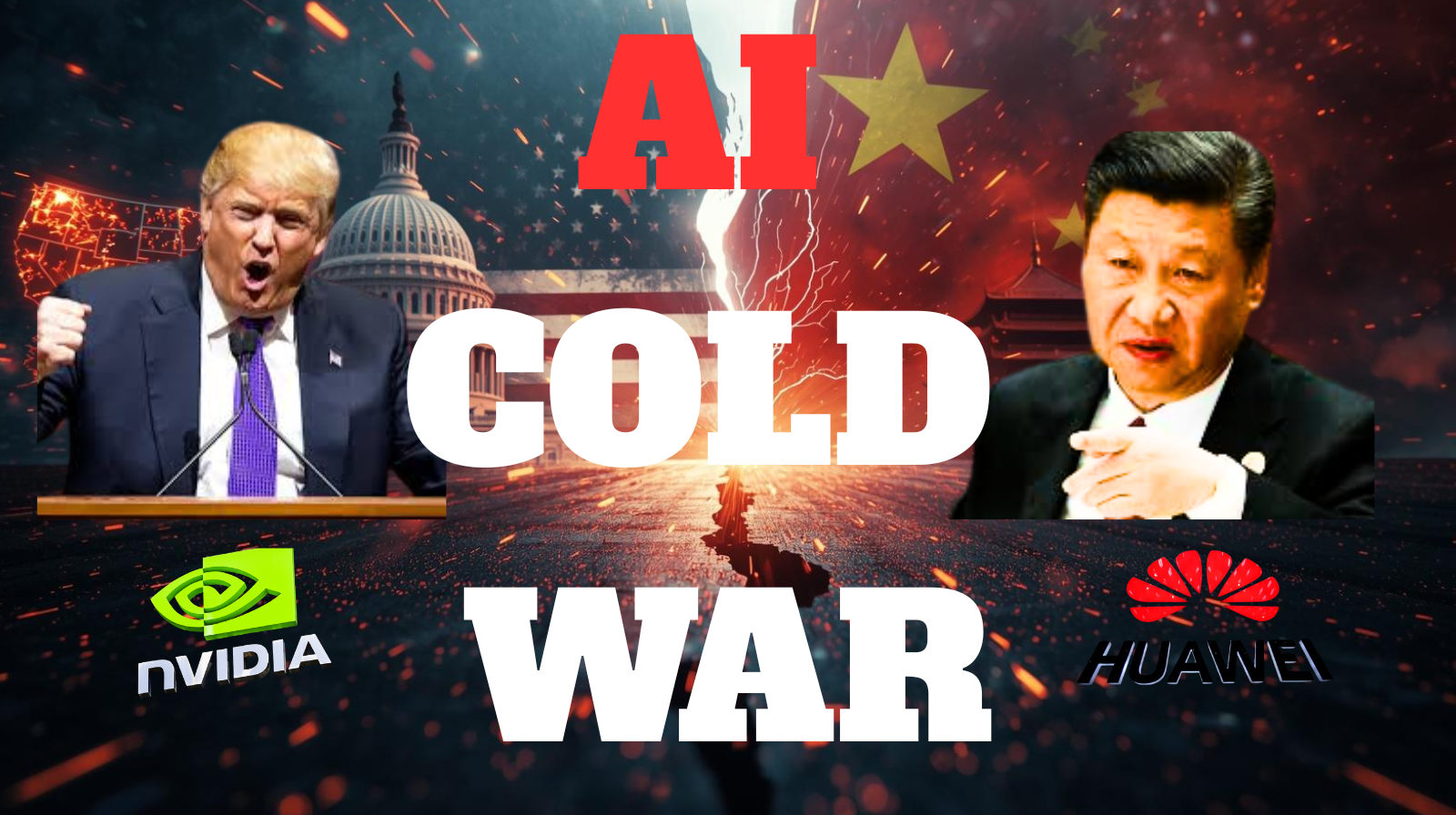
What Happened: The U.S. Chip Ban and China's Aggressive Countermove
The current conflict is not a static event, but an intensely strategic engagement, continually defined by a complex series of dynamic moves and calculated countermoves executed by the principal global powers.
The U.S. Export Controls
The U.S. government has pursued a strategy of imposing stringent export bans on advanced semiconductors, such as Nvidia's state-of-the-art Blackwell chips, to prevent them from reaching China. However, this strategy contains a critical paradox, as identified by Nvidia CEO Jensen Huang; the restrictions actively incentivize the very competition they are meant to suppress. He contends that if China loses access to Nvidia's GPUs, its tech companies will be forced to purchase "homegrown alternatives," which will pour money into local chip makers and accelerate their research and development.
This push toward self-reliance was massively accelerated by Beijing's direct response.
China's Decisive Response
In a decisive countermove, China has reportedly issued a sweeping ban on foreign AI chips from all state-funded data centers, directly impacting Nvidia, AMD, and Intel. This directive applies retroactively to any project that is less than 30% complete, a move that effectively kills any remaining prospects for Nvidia’s specially designed, compliant H20 chip in the country's massive public sector.
Why It Matters: An 'Economic Iron Curtain' Descends
This series of events is a manifestation of the AI Cold War, a narrative of geopolitical tension between the U.S. and China over supremacy in artificial intelligence technology, which is powered by advanced semiconductors. Former U.S. Treasury Secretary Hank Paulson described this growing divide as the emergence of an ‘Economic Iron Curtain.’
This conflict is fueled by massive government investment. The U.S. Senate approved the U.S. Innovation and Competition Act, which was later amended and became the CHIPS and Science Act, allocating $280 billion to boost the domestic tech and manufacturing industry. Meanwhile, China has made its ambitions clear with a state-backed plan to become the world's undisputed AI leader by 2030.
How Beijing Is Shaping the Future of Homegrown AI?
Rather than accepting a vulnerability, China has proactively adopted a comprehensive, three-pronged strategy designed to cultivate a self-sufficient and globally competitive domestic chip manufacturing sector, systematically transforming what was once seen as a critical dependency into a long-term economic and strategic asset.
1. Enforcing Homegrown Technology
China AI chips from domestic suppliers like Huawei, Cambricon, and Enflame are now mandated for all state-funded projects. This directive carries immense weight, as China has funneled more than $100 billion into these public AI infrastructure projects, creating a massive, protected market for its national champions.
2. Weaponizing Energy Costs with Subsidies
Energy is a critical bottleneck and expense in the AI race, and China is weaponizing it. Provincial governments are now offering to cut data center energy bills by up to 50%, but with a crucial condition: the data centers must run on domestic chips. This strategy is designed to directly address a key weakness: Chinese chips currently require 30-50% more electricity than an equivalent Nvidia H20 chip, and the subsidy perfectly offsets this inefficiency, making the domestic alternative economically irresistible.
3. Overcoming Weakness with "Brute Force" Innovation
To compensate for weaker individual chip performance, Huawei has pioneered a "brute force" strategy focused on superior system-level engineering. Their systems link hundreds or even thousands of Huawei Ascend chips together into a single, powerful cluster. A finding by research firm SemiAnalysis revealed that one such system outperformed a comparable Nvidia system by deploying five times the number of chips, showcasing how advanced networking can overcome limitations in individual processor power. This strategy is already bearing fruit, with Huawei supplying its CloudMatrix 384 cluster directly to former Nvidia customers and planning to launch the formidable Atlas 950 SuperCluster next year.
The Market Shockwave: Nvidia's Dominance Crumbles
The market impact of China's strategic playbook has been swift and severe, demonstrating the direct consequences of its mandates, subsidies, and system-level innovation. Nvidia, which once controlled an estimated 90% of China's AI chip market, has seen its share collapse. In a dramatic reversal of market power, Nvidia's tailored-for-China H20 chips are now reportedly being sold at a discount compared to Huawei's Ascend 910B chips. This shift has fundamentally altered the competitive landscape, cementing Huawei’s position as a viable, state-backed alternative.
Future Outlook: A World of Two AI Superpowers?
The long-term implications of this escalating tech rivalry point toward a new world order characterized by "two parallel digital ecosystems, ran by China and the US." The central question now is whether the US export controls, designed to slow China's progress, have inadvertently achieved the opposite. While Jensen Huang warns that "China is going to win," he also qualifies that "China is nanoseconds behind America in AI," highlighting a tense and rapidly closing gap. By forcing China's hand, the U.S. may have catalyzed the creation of a formidable and self-reliant competitor, fundamentally reshaping the future of global technology.
Hungry for More Insights?
Don't stop here. Dive into our full library of articles on AI, Agile, and the future of tech.
Read More BlogsFrequently Asked Questions (FAQs)
1. Why are energy costs so central to the AI chip war?
AI data centers are incredibly power-hungry. China is leveraging this by offering up to 50% energy subsidies to companies that use domestic chips. This move directly offsets the fact that current Chinese chips are 30-50% less energy-efficient than Nvidia's, making them economically viable and creating a powerful incentive for their adoption.
2. If Chinese chips are individually less powerful, how is Huawei competing with Nvidia?
Huawei is compensating for weaker individual chip performance with advanced system design and networking. Their strategy involves creating massive clusters, like the CloudMatrix and Atlas systems, that link thousands of their Ascend chips together to achieve superior overall computing power for training AI models. In some cases, these clusters have demonstrated the ability to outperform Nvidia's systems.
3. Are U.S. sanctions on China's AI industry actually working?
While the sanctions have successfully cut off China from top-tier foreign chips and reduced Nvidia's market share to "basically zero," they are also forcing China to accelerate its domestic chip industry. Experts like Nvidia's Jensen Huang argue this government-mandated push for self-reliance is likely to create a stronger, homegrown competitor in the long run.
Sources and references:
- ‘China is going to win the AI race’- Nvidia CEO Jensen Huang decries the price of electricity in the US, contrasts it with China's subsidized pricing
- China bans foreign AI chips from state-funded data centers, report claims — crackdown would include removing Nvidia, AMD, and Intel chips from builds in early stages
- China offers to help tech companies solve 'major AI problem’ but on one condition
- Huawei claims to have the ‘most powerful’ AI chip cluster globally as Nvidia faces increasing challenges in China
- Huawei becomes a strong competitor to Nvidia in China’s AI chip market
- Huawei supplying new AI chip cluster to ex-Nvidia’s customers in China